Nowadays, composite materials are widely used in engineering and are considered to be materials of the future. In many industries, traditional materials are being replaced with the composites. Despite the wide use of the composites, unexpected collapses of engineering constructions still happen. This can be explained by difficulties in detection and forecasting of early changes of mechanical properties of materials. Therefore, it is necessary to develop methods for diagnostics of early destruction. An effective way to identify early destruction is to use in situ methods during mechanical loading of the materials. The new methods based on two different approaches are being developed in the project.
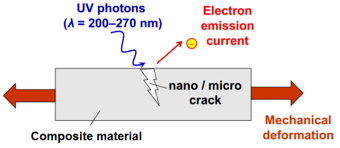
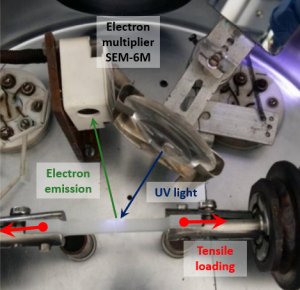
The first method utilizes measurements of photoelectron emission during mechanical loading of the composites. During mechanical destruction, electrons are emitted from a material surface, energy for the emission is provided as a result of crack formation. To increase electron emission current, the spot of destruction is illuminated with ultraviolet photons. The photoemission method allows to study the early destruction of the materials by observing changes of surface electronic properties resulting from crack formation process.
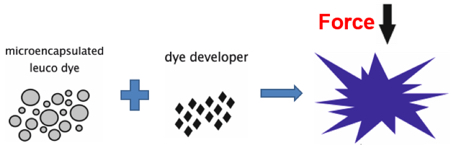
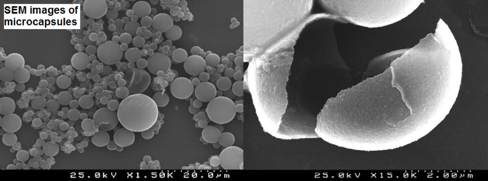
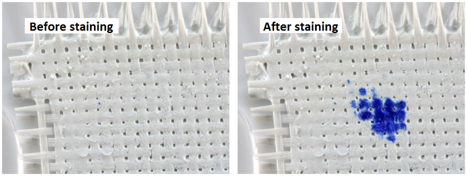
The second method uses staining of the place of destruction. This is achieved by incorporating two types of microcapsules into composites: (1) the microcapsules with low viscosity dye and (2) the microcapsules with the dye developer. The shells of the microcapsules break at a local overload and the dye reacts chemically with the developer. As the result, the damaged place is stained. This method allows to simplify monitoring of technical conditions of engineering constructions and reduce time required for large area inspection.
Application of both methods will be verified taking into account aims and needs of enterprises working in the field of testing and production of polymer composite materials. The recommendations on the use of the methods in enterprises will be developed.












 A. Aniskevich, O. Bulderberga, Y. Dekhtyar, V. Denisova, K. Gruskevica, T. Juhna, I. Kozak, M. Romanova. Coloured reactions and emission of electrons towards early diagnostics of polymer materials overloading. 2nd International Conference “Innovative Materials, Structures and Technologies, September 30.- October 2., Riga, Latvia.
  Ē. Dombrovskis, I. Kozaks, K. Gruškeviča, J. Dehtjars. Diagnostic method for early collapse of polymer pipes under mechanical load. Riga Technical University 56th International Scientific Conference, October 14-16, 2015, Riga, Latvia.
 A. Aniskevich, V. Kulakov. Express procedure for evaluation of durability of complex shape pultruded composite profiles. Baltic Polymer Symposium 2015, September 16-18, 2015, Sigulda, Latvia.
  A. Aniskevich, O. Bulderberga, Yu. Dekhtyar, A. Korvena-Kosakovska, I. Kozak, M. Romanova. “Electron emission of the carbon nanotube-reinforced epoxy surface nano layer towards detection of its destruction induced by elastic deformation”. International Nanotechnology Conference & Expo (Nanotech-2016), April 4-6, 2016, Baltimore, USA.
 D. Zeleniakiene, V. Leisis, P. Griskevicius, O. Bulderberga, A. Aniskevich. “A Numerical Simulation of Mechanical Properties of Smart Polymer Composite with Microcapsules for Damage Sensing Applications”. Poster No. PO-3-02, ECCM17 – 17th European Conference on Composite Materials, June 26-30, 2016, Munich, Germany.
  Yu. Dekhtyar, A. Aniškevičs, A. Balodis, O. Bulderberga, K. Gruškeviča, M. Romanova. “Material mechanical micro- nano- scaled features and their impact on human safety”. Riga Technical University 57th International Scientific Conference, October 14-18, 2016, Rīga, Latvija,
  K. Gruskevica, V. Denisova, I. Kozaks, A. Lobanovs, J. Dehtjars, M. Romanova. The effect of bacteria on the destruction of the drinking water distribution system polymer pipes. 3rd International Conference “Innovative Materials, Structures and Technologies”, 2017, September 27-29, Riga, Latvia.